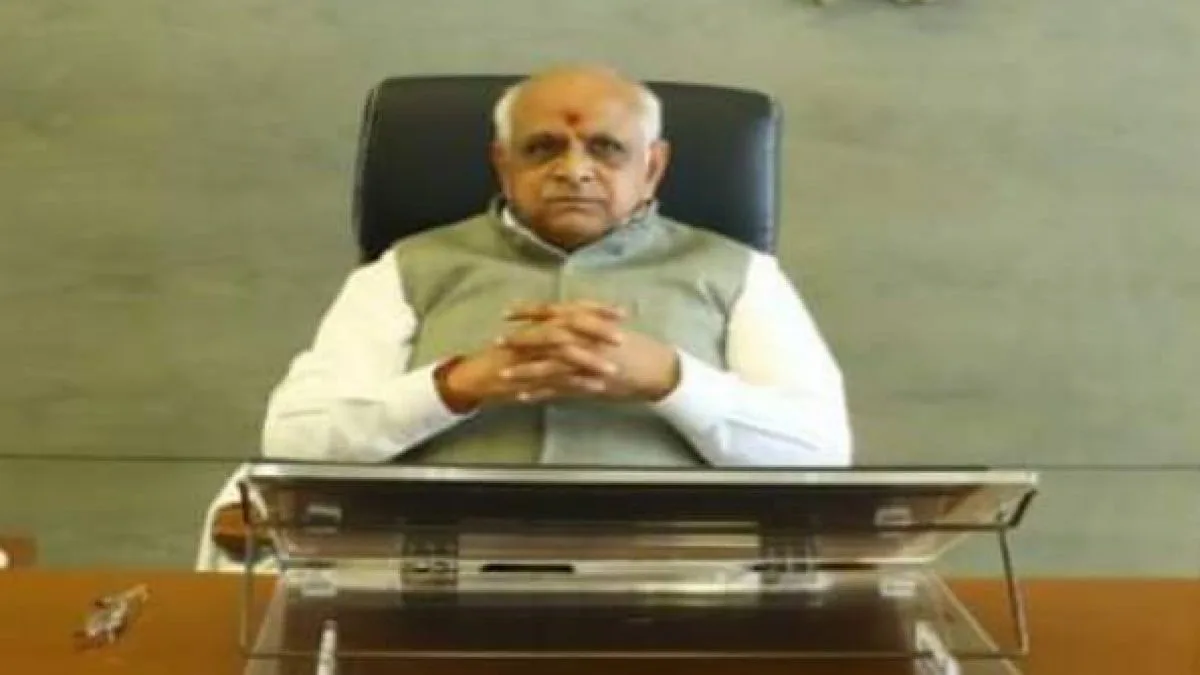
Gujarat Chief Minister Bhupendra Patel has stated that under the guidance of NITI Aayog, a master plan has been approved to develop Surat as a growth hub, with projections that the region will grow twenty fold by 2047 and contribute over 35 per cent to Gujarat’s GSDP.
Inaugurating the third Vibrant Gujarat Regional Conference (VGRC) in Surat on Friday, the Chief Minister stated that Gujarat has adopted an innovative VGRC approach inspired by Prime Minister Narendra Modi to ensure that no region of the state is left behind in the development and that each district’s potential gets a global platform.
Advertisement
Elaborating on the strong potential of the Surat Economic Region in sectors such as chemicals and pharmaceuticals, textiles and apparel, gems and jewellery, agriculture, real estate, and tourism, Patel said the VGRC for South Gujarat will accelerate industrial development potential in districts including Surat, Tapi, Navsari, Valsad, Dang, and Bharuch.
On the occasion of Gujarat State Formation Day, the Chief Minister described this South Gujarat VGRC as a strong example of the transformation and development milestones achieved in the state since 2001 under the Prime Minister’s visionary leadership.
Highlighting Gujarat’s remarkable progress, he said the state handles 40 per cent of India’s total cargo, contributes 18 per cent to industrial output, and 15 per cent to renewable energy. The state’s own tax revenue has grown from Rs 9,000 crore to Rs 1.55 lakh crore.
He noted that Gujarat has made significant strides in agriculture, manufacturing, and services over the past 25 years.
“Sanand-Dholera has emerged as a semiconductor hub, with two semiconductor plants already operational. Due to initiatives like the Vibrant Gujarat Investors Summit, the state has become one of the largest employment generators in the country,” the Chief Minister said.
He added that six regional economic master plans covering around 20 priority sectors are being prepared to ensure each district progresses with its unique strengths toward the goal of a developed India by 2047.
Patel also announced the establishment of eight new “Smart GIDC” industrial estates across South Gujarat—two in Surat, three in Bharuch, one each in Valsad, Tapi, and Navsari—covering a total area of 5,380 acres.
Earlier, addressing the gathering, Deputy Chief Minister Harsh Sanghavi extended greetings on Gujarat Foundation Day and said the VGRC will give new momentum to the development of Surat and South Gujarat.
He said that regional conferences are now being held across four zones to expand the reach of Vibrant Gujarat.
Presenting growth data, he said Gujarat’s GDP increased from Rs 1.29 lakh crore in 2003 to Rs 7.20 lakh crore in 2012-13, and further to Rs 21.90 lakh crore in 2022–23, with projections of Rs 27.4 lakh crore by 2025.
With an 8.2 per cent contribution to India’s GDP, Gujarat has become the country’s growth engine, Sanghavi stated.
He noted a fourfold increase in MSMEs and highlighted that Gujarat leads in foreign direct investment (FDI).
He also emphasised ease of doing business and transparent governance, noting that Rs 5,619 crore in incentives were disbursed in 2024–25, including Rs 1,300 crore to 11,000 traders from Surat.
Addressing the gathering, Union Jal Shakti Minister C R Patil congratulated Surat for hosting the VGRC and highlighted Gujarat’s development success.
He mentioned that steel from Surat has been used in the Chenab Rail Bridge, the world’s highest railway bridge, and that advanced artillery manufactured in Hazira contributes to national defence.
The Union Jal Shakti Minister stressed the importance of water conservation and noted that over 7 million water structures have been created across India through public participation, enhancing water storage capacity.
On the occasion, a special postal cover was unveiled to mark the GI tag recognition for Surat’s diamond industry.
A documentary showcasing the vision of Vibrant and Developed Gujarat was also screened.
The event was attended by international dignitaries, industry leaders, government officials, and entrepreneurs from sectors such as diamonds, textiles, and manufacturing.